
Finding Residents Across Gainesville
Start with the record that naturally fits the known fact. Hall County qPublic connects an address or parcel to an assessed owner. The clerk's real-estate index connects a person's name to deeds, liens, and other recorded instruments. A court name may lead to a case number through the Hall docket gateway. Georgia's My Voter Page is meant for a voter checking their own registration, districts, polling place, and sample ballot. Older names belong in the library's digitized city directories and archive collections.
No one roll lists every Gainesville household. The tax roll chiefly names owners, not each person living in a home. A deed proves a recorded property transaction, not present occupancy. Voter information excludes people who are not registered, and protected addresses may be withheld. Treat each hit as a lead and compare at least two details before deciding it is the correct Gainesville resident.
- Check whether the address falls within Gainesville or elsewhere in Hall County using the county GIS.
- Search qPublic for the parcel and assessed owner, then note the parcel number and property address.
- Use the owner's name in the GSCCCA deed index and record the instrument, book, and page references.
- For a historical search, match the address or surname in Gainesville city directories and census schedules.
- When a known public record is not online, send a focused request to its actual custodian.
Gainesville Resident Record Keepers
Gainesville is Hall County's seat, so several of the most useful resident records are kept at the county level. The Clerk of Superior Court records real-estate instruments and keeps Superior and State Court files. The Board of Assessors maintains parcel and assessment data. Hall County Elections handles local registration work, while the Georgia Secretary of State operates voter self-service and sells prescribed voter-list products. City Hall keeps Gainesville permits, code files, business-tax records, maps, and municipal administrative records.
The office depends on the question. Ownership belongs with the assessor and clerk. A city permit belongs with Gainesville. A court filing goes to the clerk or Magistrate Court, not a general open-records queue. The detailed address chain is set out in the Gainesville street directory.
Hall Board of Assessors
2875 Browns Bridge Road
Gainesville, GA 30504
770-531-6720
Hall County Elections
2875 Browns Bridge Road
Gainesville, GA 30504
770-531-6945
Gainesville Parcels and Owners
Hall County describes qPublic as its parcel, assessment, and sales search, with weekly updates. A parcel is one mapped unit of land. Its situs address is the physical property location, while its mailing address is where the tax notice goes. Those addresses may differ. That difference can point to an owner who lives elsewhere, but it does not reveal who rents or stays at the parcel.
Open the official Hall County qPublic search before reviewing the captured interface below. The live portal should be checked for its current search modes because automated research could not verify every field or historical cutoff.
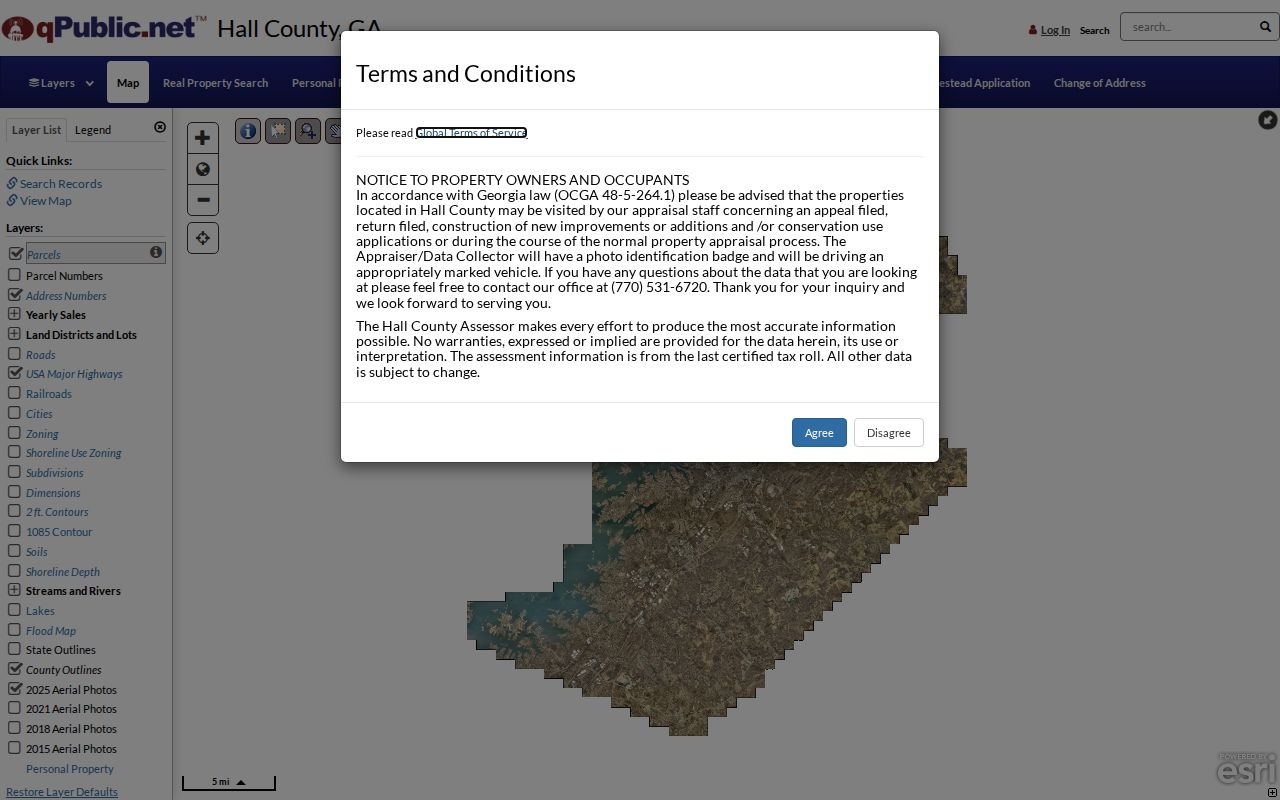
The search screen is the gateway, not proof by itself. Save the parcel number, owner name, situs address, mailing address, sale data, and legal description shown on the current record. Then compare those details with the GIS boundary and the recorded deed. Hall County says ownership corrections originate with the Deed Room, which is why the recorder remains the stronger source for the legal chain.
- Parcel
- A mapped tract used for assessment and land records.
- Situs address
- The physical address assigned to the property.
- Legal description
- The land description in the deed, often tied to a plat, lot, or boundary.
- Assessed owner
- The person or entity carried on the tax roll, which may not be every current occupant.
Gainesville Deeds Name the Parties
The Hall County Clerk's Real Estate Division and the GSCCCA search provide the recorded-property trail. Search by grantor, the party giving an interest, or grantee, the party receiving it. Deeds, liens, plats, and related instruments may establish a person's tie to a Gainesville address at a point in time. Index entries should lead to the document image or to a book and page reference. They do not prove that a named party lived on the land.
The GSCCCA Real Estate Search can be scoped to Hall County. The saved image shows the statewide grantor and grantee gateway used for that search.
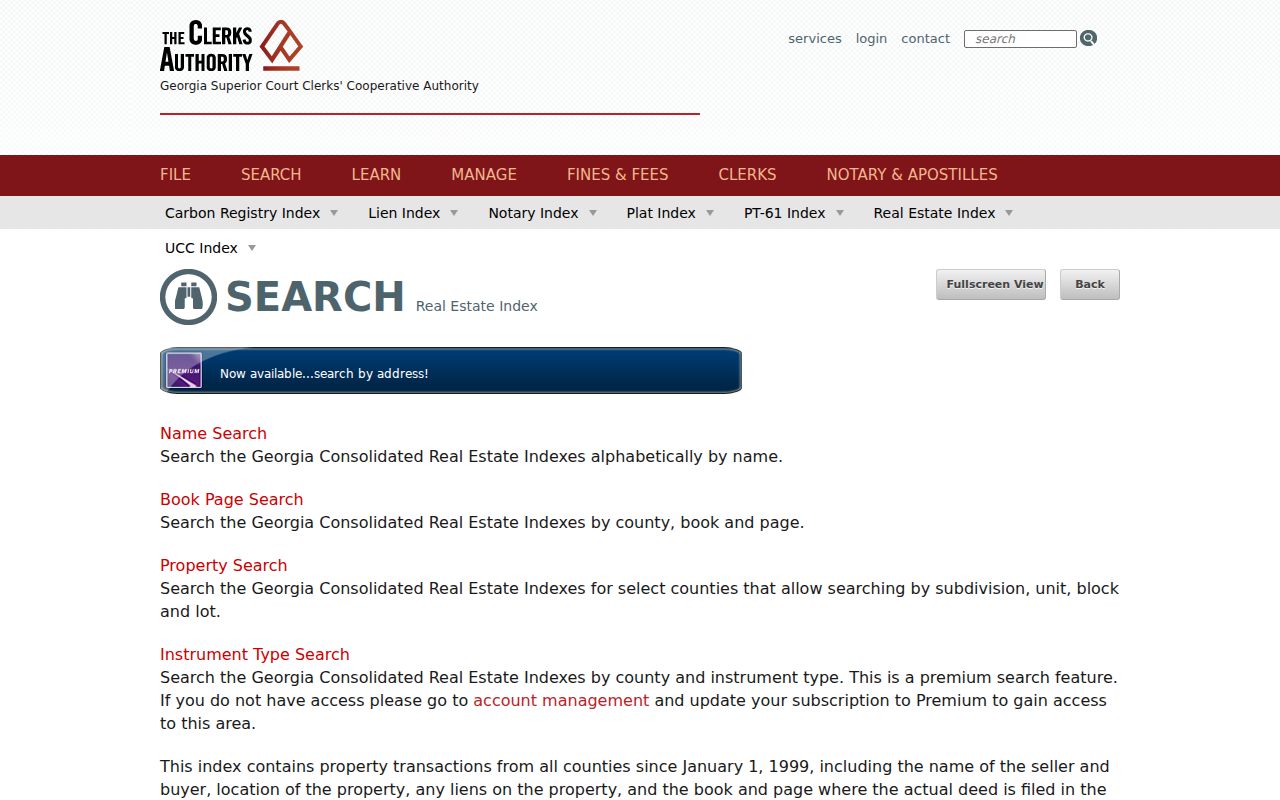
Try surname variants and a reasonable date range, then compare instrument type, recording date, legal description, and book or page. Hall's clerk also accepts counter and mail requests. Research documented copies at $0.50 per page at the counter or $1 per page by mail when the book and page are supplied. FamilySearch catalogs filmed Hall deed books from 1801 through 1901 and general indexes through 1920, giving older Gainesville research a path beyond the modern portal.
Current Gainesville Directory Sources
The Gainesville residents directory is best understood as a set of official indexes with different scopes. Choose one based on what it can actually establish. A court docket can show that a name appears in a case. A business filing can connect a person to a registered entity. A professional verification can confirm a license. None should be treated as a full household list.
| Local source | Names covered | Record keeper | Best use |
|---|---|---|---|
| qPublic assessment roll | Assessed owners | Hall County Board of Assessors | Connect an owner to a parcel |
| GSCCCA real-estate index | Grantors and grantees | Hall County Clerk and GSCCCA | Trace recorded land transactions |
| Hall Online Docket | Parties in public cases | Superior, State, and Magistrate courts | Find a case number and court |
| Georgia business search | Agents and officers where filed | Secretary of State | Verify an entity connection |
| Chamber member directory | Member businesses and contacts | Greater Hall Chamber | Locate a public business contact |
For one person, start narrow and keep a record of exact names, dates, parcel numbers, and case numbers. The Gainesville resident lookup explains how to compare those identifiers without merging same-name people.
Gainesville Voter Records Have Limits
Georgia My Voter Page is a self-lookup service. It asks for first initial, last name, county, and date of birth, then returns the user's registration status, polling place, districts, elected officials, sample ballot, and absentee-ballot functions. It is not an open-ended Gainesville people finder. The Secretary of State separately sells voter datasets in prescribed products and does not promise custom lists.
Visit the official Georgia My Voter Page to see the current verification form. The captured screen identifies the official state service and its required starting information.
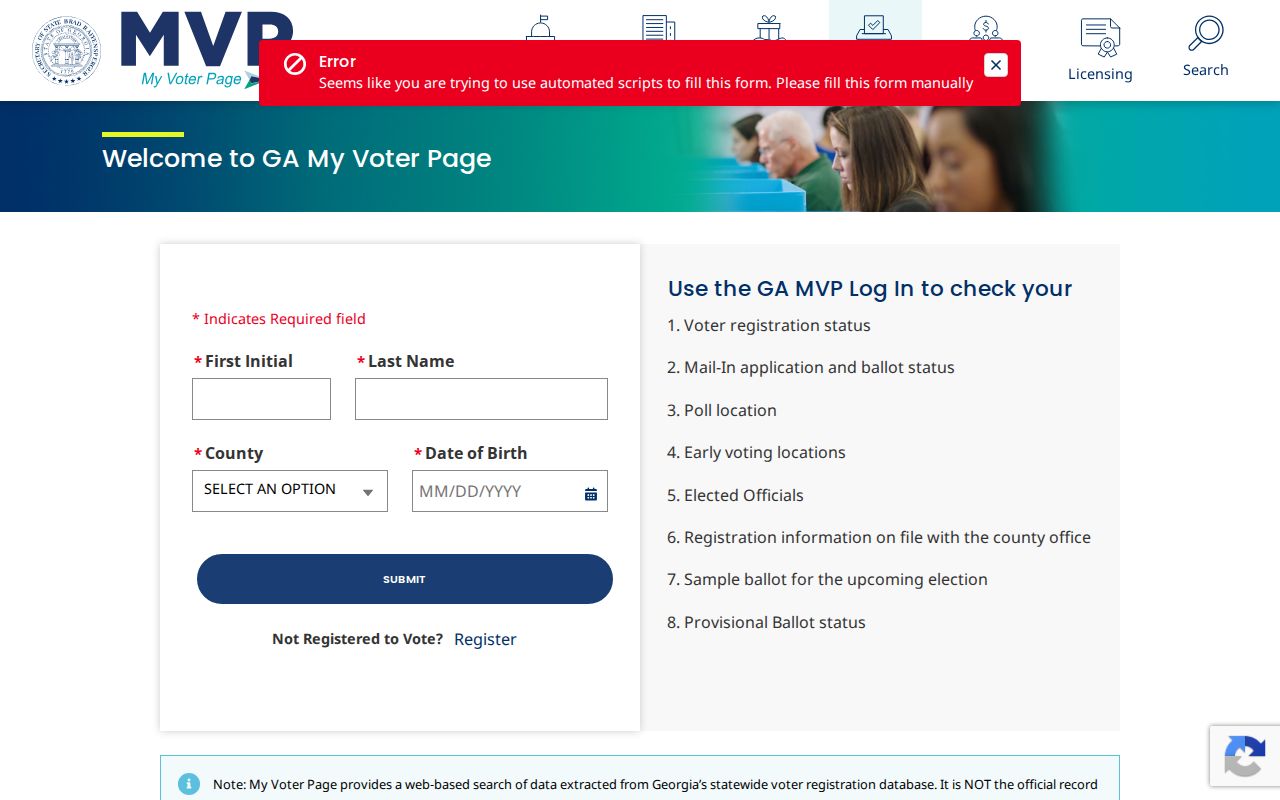
A successful response verifies the registrant's own election details. It should not be read as proof of everyone at an address. Georgia Safe at Home also provides a substitute address, mail forwarding, and confidential voter registration for eligible people whose safety would be put at risk. A protected address is a legal boundary, not a missing step to bypass.
Gainesville Court Names Need Context
The Hall Online Docket gateway separates Superior and State Courts from Magistrate Court. Superior Court handles felonies, divorce, equity, general civil matters, and real-property cases. State Court carries state-law misdemeanor, traffic, and civil work. Magistrate Court covers civil claims, dispossessory cases, and warrants within its legal jurisdiction. Gainesville Municipal Court handles city ordinance and city traffic matters, but the inspected city service showed citation payment rather than a public party-name docket.
A docket is the court's running case record. Search results may help identify a case number, parties, filing events, or status, but the downstream Hall fields and coverage dates were not verified during research. Compare the case number and file at the clerk before drawing a conclusion. Some cases and fields are sealed, restricted, or redacted. A same-name result is not proof that the Gainesville resident you seek is the party in that case.
The Hall Clerk is at 225 Green Street SE and reports public counter hours from 8:00 a.m. to 5:00 p.m. on business days. Certified court or real-estate documents can be ordered through Georgia's eCertification service. Federal Gainesville cases use PACER, which requires registration and charges $0.10 per page, generally capped at $3 per document, while quarterly charges of $30 or less are waived.
Vital Records Are Restricted
Birth and death certificates are available through Hall County Vital Records and Georgia DPH, but a modern birth certificate is not an open public directory record. Georgia requires a direct and tangible interest under O.C.G.A. § 31-10-26. Qualifying applicants need identification and, when required, proof of their relationship. Statewide birth and death coverage begins in January 1919.
Georgia DPH charges $25 for the first certified birth or death copy and $5 for each extra copy in the same order. Online ROVER adds an $8 processing fee. The state describes mail processing as 8 to 10 weeks, ordinary online processing as 2 to 4 weeks, some expedited orders as up to five business days, and walk-in service as same day. A paid FedEx option speeds shipping, not record processing.
Use the official ROVER portal for its current birth and death order choices. The saved landing screen shows those two routes and repeats the direct-interest requirement.
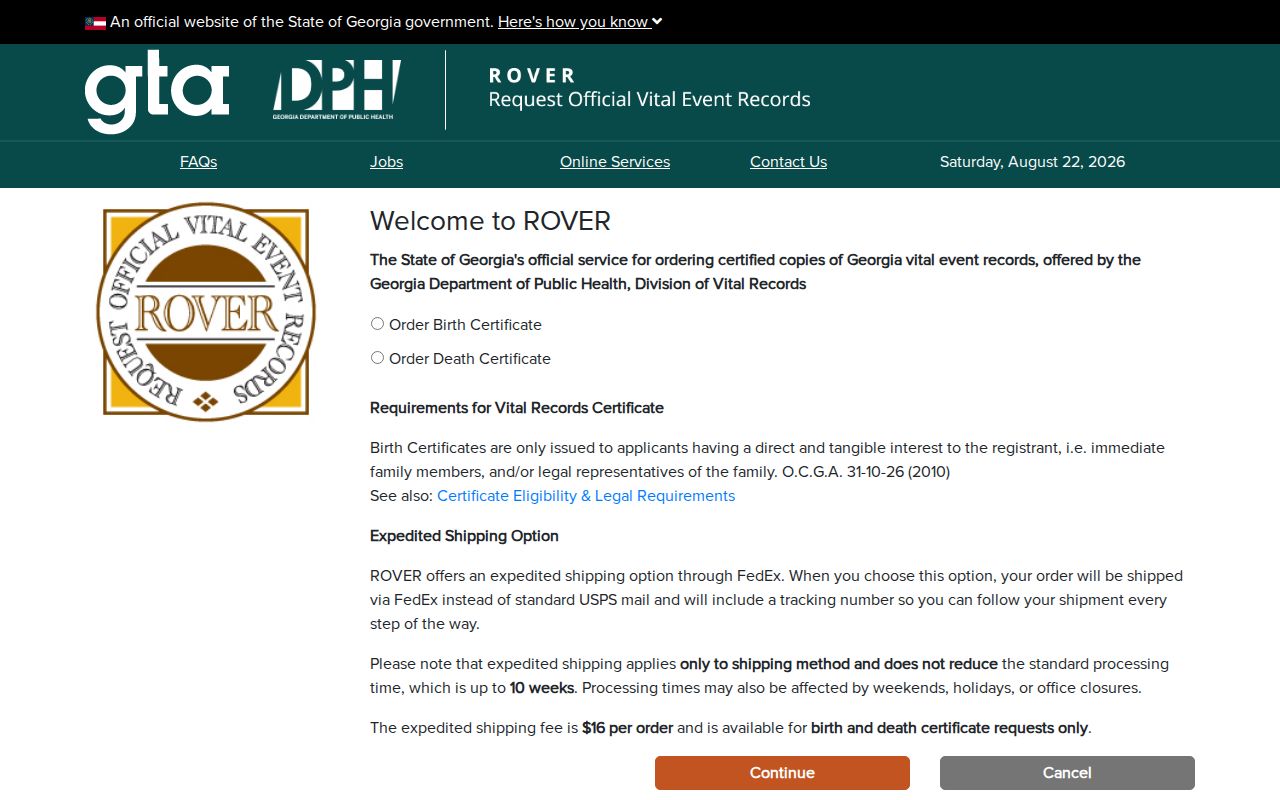
Marriage and divorce records follow different custody lines. Hall Probate Court keeps marriage licenses. DPH holds marriage applications and certificates from June 1952 through August 1996 and offers marriage verification from January 1, 2014 forward. A divorce decree comes from the Superior Court that granted it; DPH can only confirm divorces for the 1952 to 1996 interval.
Requesting Gainesville Public Records
Georgia's Open Records Act, O.C.G.A. §§ 50-18-70 through 50-18-77, calls for a response within three business days. That does not always mean every document arrives within three days. If production takes longer, the office can provide a cost and completion estimate. The first 15 minutes of administrative time are free. Later time is charged at the hourly rate of the lowest-paid qualified employee, and ordinary letter or legal copies cost $0.10 per page.
Gainesville takes requests through JustFOIA and designates a records specialist in the City Manager's Office at 300 Henry Ward Way, Suite 303. The city prefers email delivery when possible and charges $1 for certification of the first record plus $0.50 for each later record. Hall County routes general requests through NextRequest as of July 1, 2026, but Elections, Environmental Health, Sheriff, and Courts keep separate channels.
Ask for an existing record with a date range, subject, address, parcel number, or case number. Do not send a broad request to the first office found. The governor's own request form warns that its office does not hold voter registration, ballots, vital records, criminal histories, police records, professional licensing, or business licenses. Gainesville resident records work the same way: the right custodian matters more than a vague search phrase.
Verifying Gainesville Business Connections
Georgia's Corporations Division business search can connect a name to a filed entity record. Its official modes include business name, control number, registered agent, officer, and designated agent. Results concern an entity filing, not a private home directory. Confirm the entity's legal name, status, control number, and the person's filed role before treating the result as a useful match.
The Secretary of State also offers professional license verification. Research confirmed individual and facility modes, partial-name searching, and an asterisk wildcard for broader name variants. A license result can distinguish two people with similar names by profession, license type, number, and status. Gainesville business-tax and alcohol-license records are kept by the city, while the Greater Hall Chamber publishes a searchable member directory for public business contacts.
Gainesville Addresses Cross Boundaries
A Gainesville postal address can fall outside Gainesville's city government. ZIP routes were made for mail delivery, not to define city limits, court jurisdiction, taxing districts, or the correct records custodian. Hall County GIS should settle the boundary question before a city permit or code request is filed. The city and county share parcel, zoning, flood, utility, and other map layers, and their shared Citizen Access portal provides an address-keyed route into permit and code material.
Street history can also change the search. Gainesville renamed a segment of Green Street as Henry Ward Way in 2006. A current address search may therefore miss an older permit, directory entry, map, or newspaper item filed under the former name. Hall County E-911 assigns and maintains county addresses, while the county Planning Director has authority over street naming under the documented policy. Search both names when a Gainesville address spans that change.
Reading Gainesville's Older Directories
The Digital Library of Georgia presents a 17-item Gainesville city directory collection spanning intermittent editions from 1882–83 through 1960. The 1926 Mann volume contains an alphabetical resident list, abbreviations, and a street guide. A 1947 Baldwin supplement explains its numerical street directory, telephone clues, and owner marks. Polk volumes from 1952 and 1960 broaden coverage to Gainesville Mill, New Holland, and later Chicopee.
A printed entry can supply a resident's name, spouse, occupation, employer, home address, or an owner symbol, depending on the year. Absence is not proof that someone was not present. Editions are intermittent, names may be abbreviated, street numbers may change, and some households were never listed. Compare a directory entry with a deed, census schedule, obituary, newspaper, cemetery record, or map from the same period.
Hall County Library System supports genealogy research and provides NewsBank resources, including Gainesville Times coverage for 2018 through 2023 in the researched collection. Brenau University's archives and special collections, the Hall County Black History Society photo collection, Alta Vista Cemetery records, and Library of Congress Sanborn maps add family, place, and building context. Gainesville map editions in the Sanborn series extend from the late nineteenth century into the twentieth.
These collections make the Gainesville residents directory useful across time, not just for a current name. The full volume-by-volume shelf, publisher changes, street-guide methods, and historical address cautions are covered in the city directories section of the site.